
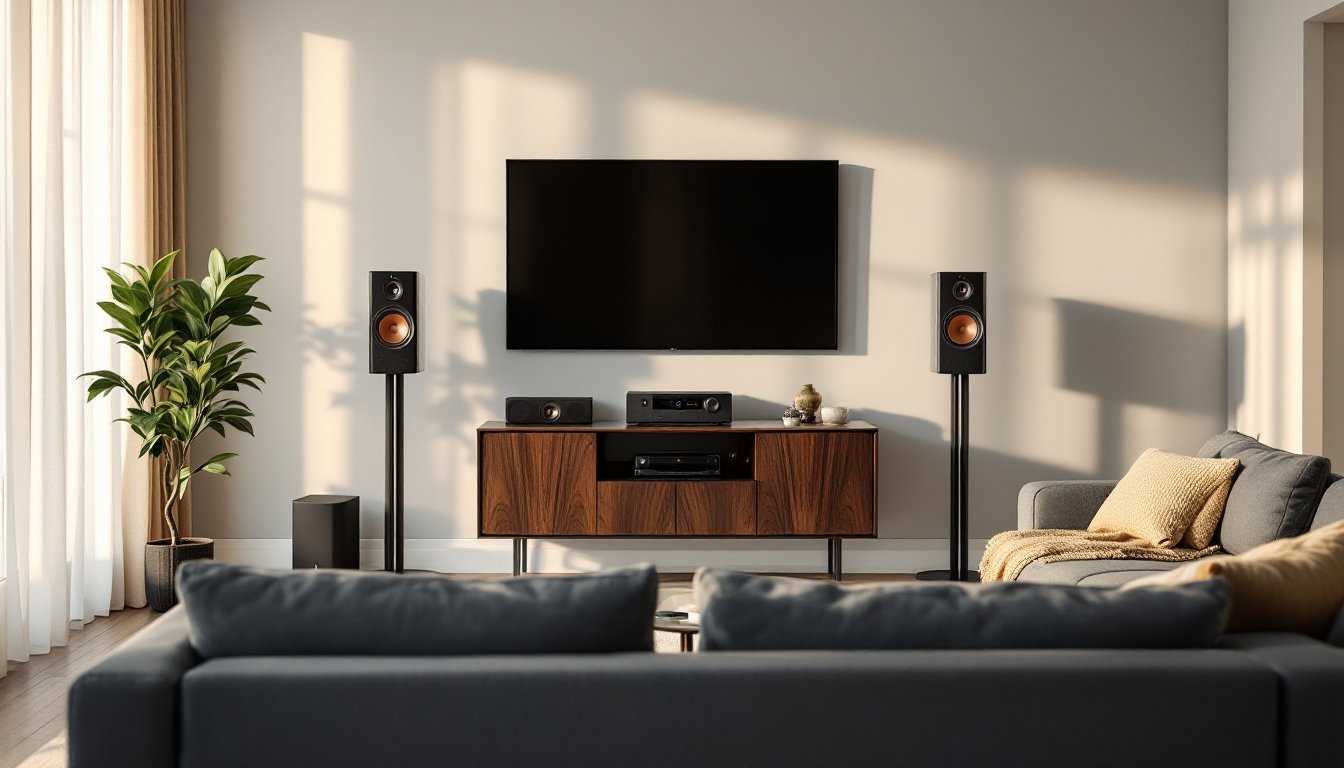
Setting up a home theater isn’t just about buying the biggest TV you can afford. Audio quality makes or breaks the experience, dialogue you can actually hear, explosions that rumble through your chest, and soundtracks that pull you into the scene. Klipsch has been building speakers since 1946, and their horn-loaded technology delivers the kind of dynamic range and efficiency that makes movie nights feel like theatrical events. Whether you’re upgrading from a soundbar or building a dedicated 5.1 or 7.1 system, understanding what makes Klipsch stand out, and how to install their speakers properly, will help you get cinema-quality sound without hiring an AV contractor.
Table of Contents
ToggleKey Takeaways
- Klipsch home theater speakers use proprietary Tractrix horn-loaded technology to achieve 95+ dB sensitivity, delivering cinema-quality sound with less amplifier power and reduced distortion compared to conventional dome tweeters.
- For small rooms under 200 square feet, pair Klipsch Reference bookshelf speakers with a compact subwoofer; for larger spaces, tower models like the RP-8000F II provide deeper bass extension and higher dynamic range for movie soundtracks.
- Proper speaker placement, including angling front speakers 10–15 degrees inward and mounting surrounds at 5–6 feet height, maximizes directional focus and prevents comb filtering that degrades dialogue clarity.
- Klipsch speakers’ high efficiency makes them compatible with modest 50–100 watt receivers and forgiving with older equipment, eliminating the need for expensive amplification upgrades.
- Use 14-gauge CL2/CL3-rated in-wall speaker wire with correct polarity connection, and run your receiver’s room correction software to optimize frequency response and speaker levels for reference-quality audio.
- Connect your receiver to your TV via HDMI eARC rather than optical connections to ensure lossless Dolby Atmos passthrough from streaming services and preserve the full dynamic impact of Klipsch home theater systems.
Why Choose Klipsch for Your Home Theater Setup?
Klipsch speakers use horn-loaded compression drivers for their tweeters, a design that’s been the company’s signature since founder Paul W. Klipsch patented the Klipschorn in 1945. This approach increases efficiency dramatically, most Klipsch speakers hit 95 dB sensitivity or higher, meaning they produce more volume with less amplifier power compared to conventional dome tweeters that typically sit around 85–88 dB.
That efficiency translates to cleaner dynamics. When a car chase erupts on screen, the speakers don’t strain to hit peak levels, so you get less distortion and better detail in both quiet dialogue and explosive action sequences. The horn design also controls directivity, focusing sound toward the listening position rather than scattering it around the room.
Klipsch builds their cabinets from MDF (medium-density fiberboard) with internal bracing to reduce cabinet resonance. Their Reference and Reference Premiere lines use copper-spun woofers with proprietary rubber surrounds that handle high excursion without bottoming out. For home theater use, this means bass stays tight and punchy even when you’re pushing volume during a Dolby Atmos mix.
Another practical advantage: Klipsch speakers are widely available and competitively priced compared to boutique brands. A Reference Premiere 5.1 system runs around $2,000–$3,000 depending on sales, while their entry-level Reference series starts under $1,000 for a complete surround package. That pricing makes high-efficiency audio accessible without requiring exotic amplification.
Understanding Klipsch Speaker Technology and Design
The Tractrix horn is the core of Klipsch’s sound signature. Unlike exponential horns used in some PA systems, the Tractrix geometry minimizes coloration and improves high-frequency dispersion. The tweeter sits at the throat of the horn, and the horn itself acts as an acoustic transformer, matching the tweeter’s impedance to the room’s air load. This reduces the power needed to achieve a given output level and lowers distortion.
Klipsch pairs these horns with 1-inch titanium dome tweeters in their Reference Premiere line and aluminum tweeters in the standard Reference series. Titanium is lighter and stiffer, extending high-frequency response to around 25 kHz and improving transient response. You’ll notice this in film soundtracks, cymbal crashes sound crisp, not harsh, and dialogue sibilance stays natural.
For bass drivers, Klipsch uses Cerametallic or copper-spun woofers depending on the series. Cerametallic cones combine aluminum with ceramic to increase rigidity, which reduces cone breakup modes that cause midrange muddiness. Copper woofers are lighter and more cost-effective but still deliver solid midbass punch for home theater use.
Many Klipsch tower speakers include a rear-firing Tractrix port. This port design reduces port noise (chuffing) at high output levels and allows for deeper bass extension without requiring a larger cabinet. When placing these speakers, leave at least 6–12 inches between the rear port and the wall to prevent bass blooming. If space is tight, consider plugging the port with foam (some models include port plugs) and letting your subwoofer handle frequencies below 80 Hz.
Top Klipsch Home Theater Speaker Systems for Different Room Sizes
Compact Spaces and Small Rooms
For rooms under 200 square feet (roughly 12′ × 15′), the Klipsch Reference Theater Pack or Reference R-41M bookshelf speakers paired with an R-10SW or R-12SW subwoofer deliver full-range sound without overwhelming the space. The R-41M uses a 4-inch woofer and 1-inch aluminum tweeter, and at 90 dB sensitivity, they’ll play loud enough for movie night with a modest 50-watt receiver.
Mount the R-41M speakers as fronts on stands (aim tweeters at ear height when seated, typically 36–42 inches off the floor). Add an R-52C center channel for dialogue clarity, it uses dual 5.25-inch woofers and matches the tonal signature of the R-41M. For surrounds, use another pair of R-41M or go with Klipsch’s R-41SA Dolby Atmos elevation speakers if your receiver supports height channels.
The subwoofer placement matters more than the brand. Corner loading (placing the sub in a room corner) increases boundary gain and makes a 10-inch sub sound closer to a 12-inch. Run your receiver’s auto-calibration (Audyssey, YPAO, or Dirac) after setup, but manually verify the crossover is set to 80 Hz for all speakers except the subwoofer, which should be set to LFE.
Medium to Large Living Rooms
For spaces 250–400 square feet or larger, tower speakers provide more output and deeper bass extension without requiring additional amplification. The Klipsch Reference Premiere RP-8000F II or RP-6000F II towers work well here. The RP-8000F II uses dual 8-inch Cerametallic woofers and a 1-inch titanium tweeter, with sensitivity rated at 98 dB, among the highest in the consumer speaker market.
Pair these with the RP-504C II center channel, which uses a quad 5.25-inch woofer array for increased dynamic range during dialogue-heavy scenes. Independent reviews from testing panels confirm that Klipsch’s center channels handle compressed streaming audio better than many competitors, maintaining intelligibility even when Netflix or Disney+ downmix to lossy codecs.
For surrounds, the RP-500SA II Dolby Atmos speakers can be placed on top of the towers (they fire upward to reflect off the ceiling) or mounted as side/rear surrounds. If your ceiling height exceeds 9 feet or has irregular angles, skip the upward-firing modules and install in-ceiling speakers like the CDT-5650-C II instead.
Add a Klipsch R-115SW or SPL-150 subwoofer for rooms over 300 square feet. The SPL-150 uses a 15-inch driver with a 400-watt continuous (800-watt peak) Class D amplifier and digs down to 18 Hz. Place it using the “subwoofer crawl” method: put the sub at your main listening position, play bass-heavy content, then crawl around the room’s perimeter to find where bass sounds smoothest and most even. That’s where the sub should go.
Installation Tips for Optimal Klipsch Speaker Performance
Start with speaker placement. For a 5.1 setup, position the front left and right towers 6–8 feet apart (measured from tweeter to tweeter) and angled inward 10–15 degrees toward the primary seating position. The center channel should sit directly above or below your TV, with the tweeter at the same height as the seated listener’s ears. If the center sits inside a cabinet, pull it to the front edge, recessing it causes comb filtering that muddies dialogue.
Surround speakers in a 5.1 system should be placed 90–110 degrees from the center axis, slightly above ear level (around 5–6 feet high). Klipsch surrounds are designed for both direct radiation and diffuse output, so mounting them on side walls works better than placing them on stands behind the couch.
Use 14-gauge speaker wire for runs under 50 feet and 12-gauge for longer distances. Klipsch speakers have binding posts that accept banana plugs, spade connectors, or bare wire. Strip 1/2 inch of insulation, twist the strands tight, and ensure polarity is correct (red to red, black to black). Reversed polarity won’t damage anything, but it will cause phase cancellation that weakens bass and blurs imaging.
Safety note: If you’re running wire through walls or ceilings, use CL2 or CL3-rated in-wall speaker cable to meet fire codes. Standard speaker wire isn’t rated for in-wall use in most jurisdictions per the National Electrical Code (NEC) Article 725.
After wiring, run your receiver’s room correction software. These systems use a calibration microphone to measure frequency response and adjust EQ, delay, and levels. Klipsch’s high efficiency means the auto-calibration may set speaker levels lower than expected, that’s normal. Don’t manually boost the levels unless dialogue sounds too quiet after calibration.
Finally, give speakers a 20-hour break-in period before making final adjustments. The rubber surrounds on the woofers will loosen slightly, and bass will deepen. Some users report the Tractrix horns also smooth out after initial use, though this is more subjective.
Pairing Klipsch Speakers with Your Existing Home Setup
Klipsch’s high sensitivity makes them forgiving with receiver choice, but matching impedance and power handling prevents issues. Most Klipsch home theater speakers are 8-ohm nominal impedance, which is easier to drive than 4-ohm speakers. A receiver rated for 75–100 watts per channel into 8 ohms will power a Klipsch system to reference levels (105 dB peaks) in most rooms.
If you’re using an older receiver, verify it supports the Dolby Atmos or DTS:X codecs if you’re adding height channels. Budget receivers like the Denon AVR-S660H or Yamaha RX-V6A handle 5.1.2 setups and include room correction. For 7.1.4 or larger systems, step up to models with pre-outs so you can add external amplification later without replacing the receiver.
Klipsch speakers work well with both solid-state and tube amplification. Some audiophiles pair Klipsch horns with low-wattage tube amps (even 10–20 watts) for stereo music listening, but for home theater use, stick with solid-state Class AB or Class D receivers. Tube amps can’t deliver the transient current needed for explosive movie soundtracks without clipping.
If you’re integrating Klipsch speakers into a multi-room audio system, their efficiency helps when running longer wire runs to secondary zones. A 100-watt amp driving speakers in Zone 2 won’t struggle with voltage drop the way less efficient speakers might.
For streaming, connect your receiver via HDMI eARC (enhanced Audio Return Channel) to your TV. This allows lossless Atmos passthrough from apps like Netflix, Apple TV+, or Disney+. Optical (Toslink) connections can’t carry Atmos metadata, limiting you to standard Dolby Digital 5.1.
Finally, if you’re mixing Klipsch speakers with other brands (not ideal but sometimes necessary), match the center channel to your front speakers’ brand. The center handles 60–70% of a film’s soundtrack, and timbral mismatches between the center and fronts create a disjointed soundstage. If you already own non-Klipsch towers, consider replacing just the center with a Klipsch model only if it closely matches the sensitivity and tonal balance of your mains. Otherwise, keep the center matched to the front speakers.