Kitchen remodels consistently deliver the highest return on investment of any home renovation, but only when the design choices have staying power. In 2026, the trends aren’t just about aesthetics: they’re about creating kitchens that work smarter, last longer, and reflect personality without sacrificing function. Whether planning a full gut job or a targeted refresh with new cabinets and counters, understanding what’s gaining traction helps homeowners make decisions they won’t regret in three years. From bold color moves to tech integrations that actually solve problems, these trends balance style with the practical demands of a hardworking kitchen.
Table of Contents
ToggleKey Takeaways
- Kitchen remodel trends in 2026 prioritize bold color palettes, smart storage solutions, and sustainable materials that deliver lasting value beyond aesthetics.
- Drawer-based cabinets, full-height pantries, and corner storage innovations maximize efficiency in modern kitchens where every inch counts.
- Statement lighting fixtures, mixed metal finishes, and practical smart technology—like touchless faucets and induction cooktops—add both personality and function without sacrificing usability.
- Sustainable choices including reclaimed wood, recycled-content countertops, low-VOC finishes, and ENERGY STAR appliances now perform at price points comparable to traditional options.
- Successful kitchen remodels balance trendy design moves with real-world testing: sample bold colors under natural light, mock up storage with cardboard boxes, and verify electrical capacity before investing in smart appliances.
Bold Color Palettes Are Taking Over Kitchen Design
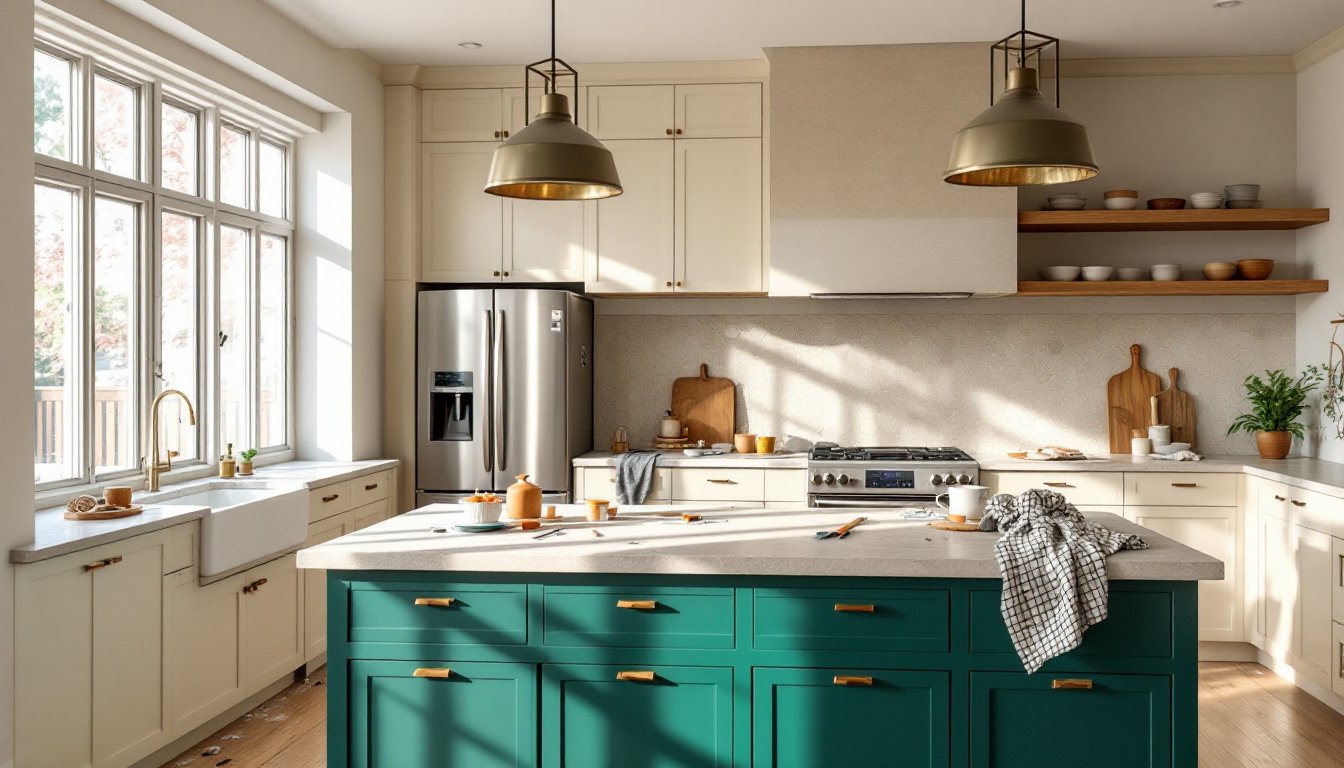
White-on-white kitchens aren’t disappearing, but they’re no longer the default. Homeowners are embracing saturated colors, deep greens, navy blues, terracotta, and even charcoal black, on cabinetry, islands, and accent walls. These aren’t trendy pastels that’ll feel dated in 18 months: they’re grounded, architectural colors that anchor a space.
Two-tone cabinetry remains strong: pairing a bold lower cabinet color with lighter uppers (or vice versa) adds depth without overwhelming a room. For DIYers tackling a cabinet refresh, this means careful prep work. Sand existing finishes with 120-grit then 220-grit paper, clean with TSP, prime with a bonding primer like Zinsser B-I-N, and use a high-quality cabinet enamel. Brushing shows streaks: a HVLP sprayer or high-density foam roller delivers a factory-smooth finish.
Colorful backsplashes are also having a moment. Zellige tile, handmade Moroccan clay tile with an undulating, glossy surface, adds texture and color variation that feels custom. Installation requires a skilled hand or a patient DIYer: the tiles aren’t uniform, so layout and spacer use gets tricky. If budgeting a pro install, expect $25–$40 per square foot including materials and labor in most markets.
Warning: Bold color works best when the kitchen gets good natural light. Test samples on multiple walls and view them at different times of day before committing to two gallons of Forest Canopy Green.
Smart Storage Solutions That Maximize Every Inch
Kitchens are shrinking in new builds, and older homes often have layouts that waste vertical or corner space. The 2026 response is hyper-efficient storage that makes every cubic inch work.
Drawer-based cabinets are replacing lower door cabinets almost universally. Deep drawers with full-extension soft-close slides (rated for 100+ lbs) provide better access to pots, appliances, and pantry goods than a dark cabinet with a single shelf. Retrofitting existing cabinets with drawer systems is doable, companies like Rev-A-Shelf make pull-out kits, but the cabinet box must be structurally sound and at least 12 inches deep.
Corner storage has evolved past the lazy Susan. LeMans corner units and Magic Corner pull-outs bring the back corner contents to you, though they require precise installation and eat into usable width. For DIY builds, a simple diagonal corner drawer stack wastes less space than a blind corner.
Vertical storage is critical. Tall pantry cabinets (84 inches or full-height to the ceiling) fitted with pull-out shelves or wire baskets keep dry goods visible and accessible. If building custom, frame for 84-inch or 90-inch cabinets during the rough-in stage: adding height later means demo.
Toe-kick drawers, shallow drawers built into the 4-inch space beneath base cabinets, are clever for storing sheet pans, cutting boards, or kids’ plastic dishes. They require undermount slides rated for side-mount installation and careful measuring so they don’t interfere with cabinet doors above.
Pro tip: When planning storage, mock up your most-used items in cardboard boxes cut to drawer dimensions. Real-world testing prevents expensive mistakes, like building a 30-inch pantry that can’t fit a cereal box turned sideways.
Sustainable Materials and Eco-Friendly Choices
Sustainability in kitchens is moving past greenwashed marketing into materials and methods that measurably reduce impact, or at least last long enough to avoid another remodel in a decade.
Reclaimed wood is popular for open shelving, islands, and accent details. Salvaged barn beams or old-growth lumber have tight grain and character new wood can’t match, but they need inspection for embedded nails, insect damage, and structural soundness. Plane or sand to reveal clean wood, then seal with a food-safe finish like Rubio Monocoat or hard wax oil if it’s a countertop surface.
Recycled content is showing up in countertops and tile. Materials like Vetrazzo (recycled glass and concrete) and PaperStone (paper composite) offer durability and a story, though they come with quirks: PaperStone scratches more easily than quartz, and needs periodic oiling. Many homeowners now favor natural stone or engineered materials that skip the environmental cost of virgin quarrying.
Low-VOC and zero-VOC paints, stains, and adhesives are now standard, not premium. Most major paint brands offer low-VOC lines at the same price point as traditional formulas. For tile and countertop installs, look for adhesives and grouts rated GREENGUARD Gold: they off-gas far less and meet strict indoor air quality standards.
Energy efficiency matters in appliance choices. ENERGY STAR-rated refrigerators, dishwashers, and range hoods use 10–50% less energy than standard models, and the upfront cost difference has narrowed. Induction cooktops are wildly efficient, 90% of energy goes into the pan vs. 65% for gas, and falling in price. A 30-inch induction range now starts around $800.
One caution: Some eco-materials require specialized installation or maintenance. Concrete counters can crack without proper reinforcement and sealing. Cork flooring is comfortable and renewable but dents under heavy appliances. Do the assignments before demo day.
Statement Lighting as a Focal Point
Lighting used to be an afterthought in kitchen remodels, recessed cans on a dimmer, under-cabinet strips, done. In 2026, statement fixtures are the jewelry of the kitchen, and they’re doing real work.
Pendants over islands are getting larger and more sculptural. Multi-light chandeliers, oversized glass globes, and geometric metal fixtures are replacing the safe trio of mini-pendants. When sizing pendants, allow 30–36 inches of clearance from countertop to the bottom of the fixture for a standard 36-inch-high island: taller bars or counters need more. Space multiple pendants 24–30 inches apart and center them over the workspace, not just the island footprint.
Installation is straightforward if the electrical box is already in place. If not, adding a box in an existing ceiling requires fishing wire, easy in an unfinished basement below, a nightmare in a finished second story. That’s a job for an electrician unless the DIYer is comfortable working in tight spaces and dealing with live wire (always shut off the circuit breaker first).
Flush-mount and semi-flush ceiling fixtures are also evolving past builder-grade basics. Look for designs with mixed materials, brass and glass, blackened steel and wood, matte finishes with Edison bulbs. These add personality without the clearance concerns of a chandelier.
Under-cabinet lighting remains essential for task lighting. LED strip lights are the standard: choose 3000K color temperature for a warm white that doesn’t skew yellow or cold blue. Hardwired is cleaner than plug-in, but requires routing wire through the cabinet or wall, a moderate DIY skill level or a sparky’s call.
Don’t skip a dimmer. LED-compatible dimmers (not old incandescent models) give control over mood and function. Lutron and Leviton both make reliable units: match the dimmer to the bulb type or risk flickering and buzzing.
Mixed Metals and Layered Finishes
The days of matchy-matchy hardware and faucets are over. Mixing metal finishes, brushed brass with matte black, polished nickel with oil-rubbed bronze, chrome with unlacquered brass, adds dimension and feels less staged.
The key is intention. Choose a dominant metal (usually the faucet and cabinet pulls) and a secondary accent (light fixtures, bar stools, pot rack). Mixing more than three finishes in one kitchen risks looking chaotic unless the homeowner has a designer’s eye.
Unlacquered brass and copper are trending because they patina over time, developing a living finish that darkens and changes. That’s appealing to some and horrifying to others. If the goal is a consistent look, stick with PVD-coated or lacquered finishes, which resist tarnish and wear.
Hardware installation is a quick DIY win, if the new pulls match the existing hole spacing. Standard pulls are 3-inch or 96mm center-to-center: knobs are single-hole. Switching from knobs to pulls (or vice versa) means drilling new holes or filling old ones with wood filler, sanding, and touch-up paint. For clean holes in cabinet doors, use a Forstner bit or a hole saw with a backer board to prevent blowout on the back side.
Faucet upgrades are also manageable for a confident DIYer. Most kitchen faucets use standard three-hole or single-hole configurations, and manufacturers include shanks and supply lines. The trickiest part is working under the sink in cramped quarters, a basin wrench makes tightening the mounting nuts far easier. If the existing supply valves are old gate valves that haven’t been turned off in years, replace them with quarter-turn ball valves while the faucet is out. Shut off the main water supply first.
Trend to watch: integrated faucets and soap dispensers in matching finishes. They streamline the sink deck and often come as a set, ensuring the metals actually coordinate. Products from brands like Kohler and Delta now offer these in a range of finishes.
Smart Technology Integration for Modern Living
Smart kitchens aren’t science fiction anymore, they’re showing up in spec homes and DIY remodels. The difference in 2026 is that the tech is practical, not gimmicky.
Smart faucets with touchless or voice activation are useful when hands are covered in raw chicken or dough. Models from Moen and Delta integrate with Amazon Alexa or Google Home, allowing voice commands for precise measurements (“Alexa, dispense two cups”). Installation is the same as a standard faucet, plus a plug for the control box under the sink. Make sure there’s a GFCI-protected outlet within reach, per NEC code.
Smart refrigerators with internal cameras, meal planning apps, and screen displays are polarizing. They’re expensive, and many homeowners find the features underused. A more practical upgrade: adding a smart plug to an existing fridge to monitor energy use, or a standalone fridge thermometer with app alerts to catch failures before food spoils.
Induction cooktops with Wi-Fi connectivity can be controlled remotely and often include guided cooking modes. Swapping an electric cooktop for induction is straightforward if the circuit is already 240V and appropriately sized (usually 40 or 50 amps). Going from gas to induction requires running new electrical, which means a permit and likely a pro.
Touchless or sensor-activated cabinet lights are simple upgrades. Battery-powered puck lights with motion sensors install with adhesive strips, no wiring required. They’re perfect for pantries or deep cabinets.
Voice-controlled smart displays (like an Echo Show or Google Nest Hub) mounted on a wall or tucked into a cabinet end are replacing the countertop cookbook. Run in-wall power and low-voltage data during a remodel for a clean look: retro-fit power options exist but often mean visible cords.
One note: Smart devices require stable Wi-Fi. If the kitchen is in a dead zone, a mesh network extender is a cheap fix before blaming the appliances. Platforms like those highlighted on Remodelista often discuss integration tips for tech and design.
Conclusion
Kitchen trends in 2026 reward homeowners who think past the Pinterest board. Bold color and mixed materials add personality, but the real transformation comes from better storage, smarter tech, and materials chosen to last. Whether the project is a weekend cabinet refresh or a months-long gut renovation, these trends offer clear direction, and most are achievable without a general contractor’s license. Plan thoroughly, prep properly, and the results will serve well past the next trend cycle.