Building a backyard deck isn’t just adding square footage, it’s creating a room without walls, a place where mornings start with coffee and evenings end with citronella candles. Whether you’re working with a sprawling yard or a narrow strip behind a townhouse, the right deck design turns underused grass into functional living space. The options have evolved far beyond basic pressure-treated rectangles. From multi-level platforms that follow sloping terrain to ground-hugging designs that skirt permit requirements, today’s deck ideas balance aesthetics with real-world durability and building code compliance.
Table of Contents
ToggleKey Takeaways
- Multi-level backyard deck ideas solve sloped yards while creating distinct zones for dining, grilling, and entertaining by working with natural terrain rather than fighting it.
- Ground-level decks remain permit-friendly in many areas when under 30 inches high and work best on stable soil with proper footings below the frost line to prevent heaving.
- Material selection defines your maintenance burden for the next 20 years—pressure-treated lumber costs less upfront, while composites and tropical hardwoods eliminate rot but require larger initial investment.
- Built-in features like bench seating, planter boxes, and privacy screens transform a basic deck into a finished outdoor room without adding square footage.
- Proper lighting using low-voltage systems extends usability past sunset and improves safety on stairs and level transitions with warm white LEDs at 2700-3000K.
- DIY labor and simplified rectangular designs save the most money on backyard deck projects, while permits should never be skipped despite upfront costs to protect home sales and insurance claims.
Multi-Level Decks for Dynamic Outdoor Living
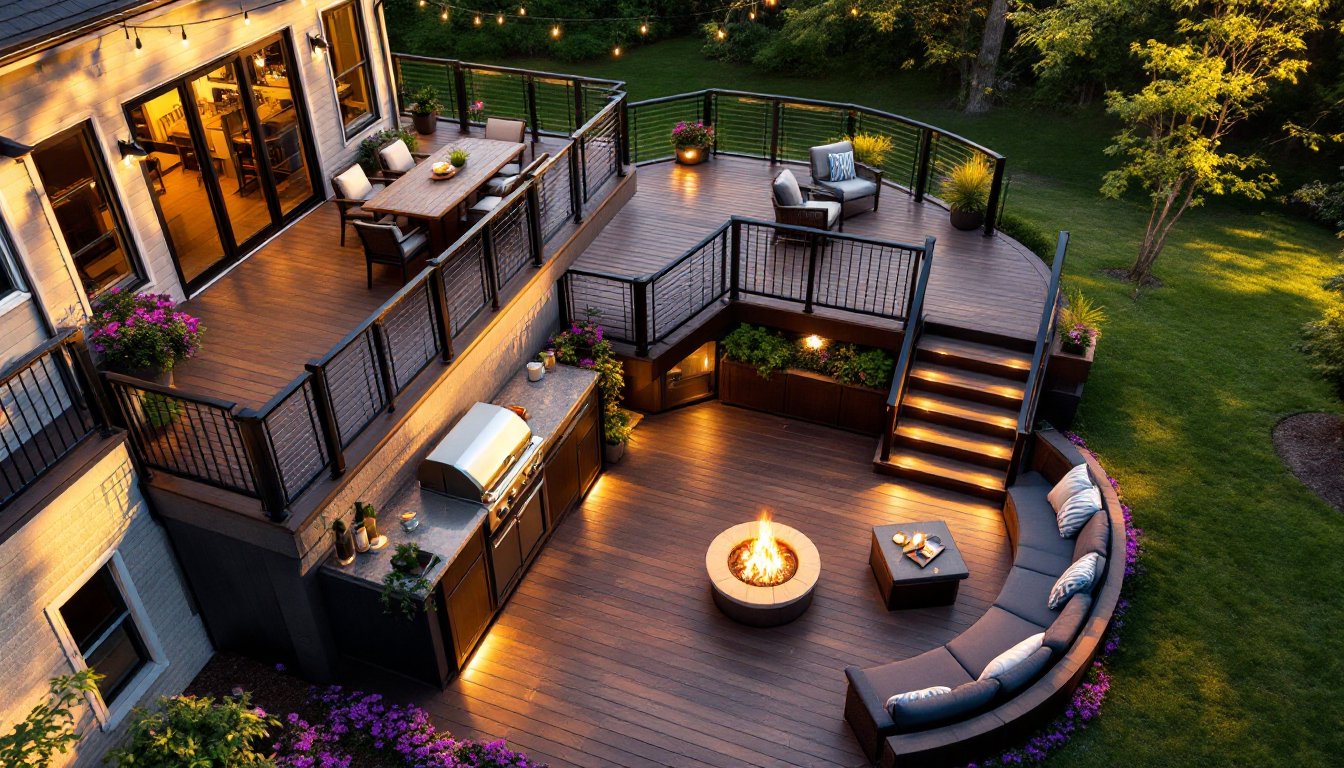
Multi-level decks solve the problem of sloped yards while creating distinct zones for different activities. Instead of fighting topography with expensive grading and retaining walls, a stepped deck design works with the natural grade. Each level can serve a purpose: upper platforms for dining, mid-levels for grilling, lower tiers for fire pits or hot tubs.
Structural considerations matter here. Multi-level designs require proper ledger board attachment at each elevation change, and posts must be sized to carry cumulative loads. Most jurisdictions classify decks over 30 inches above grade as requiring permits and inspections, expect that with multi-tier designs. Joists typically run perpendicular to the house on the upper level, then the lower deck frame ties into the upper with through-bolted rim joists or specialized hangers.
Step transitions between levels need careful planning. Code generally requires risers between 4 and 7¾ inches, and all risers in a flight must be within ⅜ inch of each other. Building two or three broad steps between levels (rather than a single tall drop) improves safety and flow. Composite or hardwood stair treads hold up better than standard decking boards under concentrated foot traffic.
Railings become more complex with elevation changes. Most codes require 36-inch guards on any walking surface more than 30 inches above grade, with balusters spaced so a 4-inch sphere can’t pass through. Cable railing systems work well on multi-level decks, they don’t block sightlines between tiers and suit contemporary designs. For those interested in creating distinct zones without the complexity of full multi-level construction, small deck configurations can serve as modular building blocks.
Cozy Ground-Level Deck Designs
Ground-level decks, often called floating decks when they’re not attached to the house, fly under the permit radar in many jurisdictions if they stay below a certain height threshold (often 30 inches). They’re ideal for flat yards, renters who want semi-permanent outdoor flooring, or DIYers tackling a first deck project.
Foundation options are simpler but still crucial. Precast concrete deck blocks work for small platforms (up to 8×10 feet) on stable, well-draining soil. For anything larger, pour footings below the frost line, even a “floating” deck can heave and crack if footings freeze and thaw. In frost-free climates, 12-inch-deep footings with embedded post anchors suffice. Space footings based on your joist span tables: 2×6 joists spanning 8 feet on 16-inch centers work for most residential loads, while 2×8s can stretch to 10-12 feet.
Ground-level designs offer creative freedom. Octagonal or angled platforms feel less like construction and more like landscape features, especially when paired with gravel borders and low-voltage lighting solutions that define edges. Surface drainage is critical, deck boards should sit at least 6 inches above soil to prevent moisture wicking and allow airflow. Slope the ground away from the deck perimeter or install a French drain if the site holds water.
Skip the stairs, but don’t skip the landing. Even an 8-inch step down from a sliding door benefits from a small gravel or paver landing pad to keep mud off the deck surface. For homeowners planning accessibility features, deck designs with ramps provide code-compliant transitions without the bulk of traditional staircases.
Deck Materials That Combine Beauty and Durability
Material choice defines both the build process and the next 20 years of maintenance. Pressure-treated pine remains the workhorse, inexpensive, widely available, and capable of 15+ years with proper sealing. It’s sold wet from the treatment process, so let it dry for a few weeks before staining. Expect warping, checking, and the occasional splinter. Nominal 5/4×6 deck boards (actual dimensions 1×5.5 inches) are standard: wider boards like 2×6s cover faster but can cup more aggressively.
Cedar and redwood bring natural rot resistance and rich color but cost 2-3 times more than PT lumber. They’re softer, easier to saw and fasten but also easier to dent. Both fade to silver-gray without annual treatment. If you’re after the look, use cedar or redwood for decking and railings, but stick with PT for the hidden structure (joists, beams, posts) to save money where it doesn’t show.
Tropical hardwoods like ipe, cumaru, and tigerwood are beautiful and last 25+ years, but they’re dense enough to dull saw blades and require pre-drilling for every fastener. They also cost $8-12 per linear foot. Most require hidden fastener systems, face-screwing diminishes the clean look and can split boards.
Composite and Low-Maintenance Options
Composite decking eliminates rot, splitting, and annual sealing. Early-generation composites had issues with fading and mold, but modern capped composites (boards with a polymer shell over a wood-fiber core) resist staining and UV damage far better. Brands vary widely, some feel plasticky underfoot, others mimic wood grain convincingly.
Installation differs from wood. Composites expand and contract more with temperature swings, requiring specific gap spacing (typically ¼ inch between board ends, ⅛ inch on sides). Most manufacturers void warranties if you don’t use their proprietary hidden fasteners. Composite boards are flexible, they need joist spacing at 12 or 16 inches on center depending on the product, and they can sag between joists if you cheat the spacing.
Cost runs $4-8 per linear foot for mid-grade composites, plus hidden fasteners add another $0.50-1.00 per square foot. The upfront premium pays off if you’d rather spend weekends on the deck instead of maintaining it. PVC decking (fully plastic, no wood fiber) costs even more but handles moisture exposure near pools or coastal areas where even capped composites can wick water through cut ends. Those looking to optimize material selection based on regional climate should consider how different lumber grades perform in high-humidity versus arid environments.
Built-In Features to Maximize Your Deck’s Functionality
Built-ins turn a deck from a flat surface into a finished outdoor room. Bench seating along the perimeter saves space and eliminates the need to store or cover furniture. Frame benches with the same joist and blocking approach as the deck itself, back support posts should tie into the rim joist or run down to dedicated footings for structural railings. Seat height of 16-18 inches works for most adults: deeper seats (18-20 inches) let people sit cross-legged but eat into deck space.
Planter boxes built into railings or corners add greenery without cluttering the deck floor. Line them with pond liner or EPDM rubber to protect the wood structure, and drill weep holes in the bottom. Size boxes to fit standard nursery pots so plantings can rotate seasonally without rebuilding soil depth.
Privacy screens made from vertical slats, lattice panels, or louvered sections block sightlines from neighbors without the expense of a full fence. Mount them to posts that extend above the deck railing, check local setback rules, as some jurisdictions count screens toward fence height limits. Cable or mesh infill between posts can support climbing vines for a living screen that matures over a few seasons, an approach common in Southern garden designs.
Outdoor kitchens range from a simple grill surround to full masonry islands with sinks and refrigerators. If you’re running gas or water lines, hire licensed tradespeople, DIY gas work is illegal in most areas and voids homeowner’s insurance. Electrical for outlets and appliances must be GFCI-protected per NEC code. Frame countertops at 36 inches (standard kitchen height), and use concrete board or metal studs for any structure near heat sources.
Deck Lighting and Ambiance Ideas
Good lighting extends deck usability past sunset and improves safety on stairs and level changes. Low-voltage systems (12V or 24V) are DIY-friendly and don’t require conduit burial like 120V line-voltage setups. A transformer steps household current down and plugs into a GFCI outlet. Wire runs up to 100 feet with 12-gauge cable before voltage drop becomes an issue.
Riser lights mounted on stair faces or post caps illuminate steps without glare. Aim for 10-20 lumens per fixture, enough to define edges but not bright enough to ruin night vision. Recessed lights set into deck boards look clean but require drilling through joists for wire runs and create potential leak points. Surface-mount puck lights install faster and can be repositioned.
String lights soften the space and feel festive, but they’re not structural lighting, expect to replace bulbs yearly and bring them in during heavy storms if they’re not rated for wet locations. For a more permanent installation, run conduit along the underside of an overhead pergola beam and hard-wire weatherproof fixtures.
Smart controls and dimmers add flexibility. Some low-voltage transformers include timers and photocells: others integrate with home automation systems for app-based control. Color-changing LEDs work well for occasional parties but can look gimmicky for daily use, stick with warm white (2700-3000K) for a natural tone that doesn’t distort food and skin tones. Incorporating ambient fire features alongside electric lighting creates layered warmth and draws people to specific zones.
Budget-Friendly Backyard Deck Projects
Deck costs spiral when designs ignore material lengths and standard dimensions. Lumber comes in 8, 10, 12, 14, and 16-foot lengths, plan deck dimensions to minimize cuts and waste. An 11-foot-wide deck forces you to buy 12-foot boards and toss a foot of each: a 10-foot width uses every inch. Similarly, joist spacing at 16 inches on center aligns with 8- and 16-foot board lengths better than 12-inch spacing.
DIY labor saves the most money. Professional deck installation runs $30-60 per square foot installed, while material-only costs land between $15-25 per square foot for PT lumber decks. A 12×16-foot deck (192 square feet) might cost $3,000-4,800 in materials but $5,760-11,520 installed. Composite materials double those figures. If framing and fastening are within your skill set, hire out only the footing excavation or electrical rough-in.
Simplify the design. Rectangular decks with minimal angle cuts and no built-in features build faster and waste less material. Save herringbone patterns and picture-frame borders for future upgrades, they require 20-30% more decking and double the cutting time. Standard deck layouts without complex angles can often be completed in a long weekend with a helper.
Buy materials strategically. Lumber prices fluctuate seasonally, late fall and winter often bring lower prices as demand drops. Big-box stores run sales around Memorial Day and Independence Day. For fasteners, hidden clips cost more than galvanized screws but reduce labor time and create cleaner lines, weigh the trade-off based on your budget and aesthetics. Salvaged or reclaimed materials can cut costs but verify they’re structurally sound and haven’t been treated with hazardous preservatives like creosote.
Permits aren’t optional savings. Skipping permits might save $200-500 upfront, but unpermitted decks complicate home sales, void insurance claims if someone gets injured, and can result in fines or mandatory teardown. Most jurisdictions offer expedited permits for simple, code-compliant designs. Budget for the permit as part of the project from day one. Reviewing diverse deck design portfolios can spark ideas that fit within material and code constraints while maintaining visual interest.